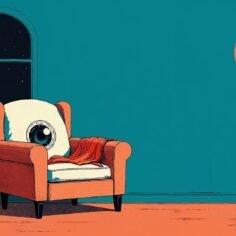

Dek: Brian Eno wrote that ambient music should bring out the peculiarities of a room. A new flood of generated music comes from no room at all. The problem is not that it sounds bad. It is that nothing happened anywhere for it to be a record of.
By Ines Calder
A Room Repeating Itself
In 1969, at the Brandeis University Electronic Music Studio, the composer Alvin Lucier sat in a room with a microphone and two tape recorders and read a short text aloud. “I am sitting in a room different from the one you are in now,” it begins. He recorded himself reading it. Then he played the recording back into the same room and recorded that. Then he played the second recording back and recorded it again. And again.
Every room has resonant frequencies, tones that its walls and floor and ceiling reinforce, and others that they swallow. Each time Lucier’s voice passed through the room, the room’s own preferences were laid on top of it. After a dozen passes, the words begin to blur. After more, they are gone. In the best-known recording, made for the Lovely Music label in 1980 in Lucier’s own living room in Middletown, Connecticut, the process runs for thirty-two generations, and what you hear at the end is not a voice but a set of shimmering, bell-like tones: the shape of the room itself, sung back to you by a man who is no longer audible.
The text Lucier reads tells you what he is doing, and it ends with a confession. He regards the activity, he says, “not so much as a demonstration of a physical fact, but, more as a way to smooth out any irregularities my speech might have.” Lucier stuttered. You can hear it in the first generation, a catch here and there in the line. By the end, the stutter has been dissolved into resonance along with everything else. The room has taken his weakness and turned it into music.
I Am Sitting in a Room is one of the founding works of what came to be called sound art, and it is usually discussed as an experiment in acoustics. I think it is better understood as a piece about provenance. It is a recording that is entirely about where it was recorded. A different room gives a different piece; Lucier performed it many times in many spaces, and the New York Times, writing about the piece in 2021, noted both the 1969 Brandeis version and a 2018 recording at the church of Saint-Merri in Paris. Same text, same method, different ending, because the ending belongs to the walls.
I start with Lucier because I have been listening, for months now, to a kind of music that is the exact reverse of his. It comes from nowhere. It has no walls. The voice in it does not stutter, and there is no room for it to dissolve into, because no one ever sat anywhere to make it.
Tint, Not Blanket
In September 1978, Brian Eno wrote the liner notes for Ambient 1: Music for Airports. The notes are short, and they are among the most quoted pieces of writing about recorded music. Eno was trying to name a kind of music he wanted to make and to separate it, firmly, from something he did not.
The thing he did not want was Muzak. The Muzak company had for decades supplied background music to offices, elevators and stores, and the point of that music, as Eno described it, was to regularize environments “by blanketing their acoustic and atmospheric idiosyncrasies.” Muzak smoothed rooms out. It made a dentist’s waiting room in Ohio sound like one in Oregon.
Ambient music, Eno said, should do the opposite. “An ambience is defined as an atmosphere, or a surrounding influence: a tint.” And then the key sentence: “Whereas the extant canned music companies proceed from the basis of regularizing environments by blanketing their acoustic and atmospheric idiosyncrasies, Ambient Music is intended to enhance these.” It was meant to “induce calm and a space to think.” And it “must be able to accommodate many levels of listening attention without enforcing one in particular; it must be as ignorable as it is interesting.”
Ignorable and interesting. That pairing has been taken, for almost half a century, as a license for wallpaper. But read the whole passage and it is a demand, not a permission. Ambient music was meant to make you notice the room you were in, the light through the airport windows, the hum of the air handling, the particular waiting you were doing. It was meant to bring out idiosyncrasies. It was music about here.
Eno’s method was partly a matter of chance. For Discreet Music, released in 1975, he set up tape loops of different lengths, by most technical accounts a little over sixty-three and sixty-eight seconds, so that the phrases would drift in and out of alignment and the piece would keep changing without anyone changing it. He called this kind of system generative. He was, in other words, one of the first popular musicians to let a process make music for him.
That makes him the obvious patron saint of the machines now making music for everyone. And it makes his liner notes the obvious standard to hold them to.
The Flood
In April 2025, the French streaming service Deezer said that more than twenty thousand fully AI-generated tracks were being delivered to it every day, more than eighteen percent of all new uploads. That figure was rising: it had been about ten percent in January, when Deezer launched a tool to detect such tracks.
In the summer of 2025, a band called The Velvet Sundown gathered a large audience on Spotify with a run of mellow, vaguely Laurel Canyon rock. Listeners grew suspicious: the band photos looked generated, there were no interviews, no concerts. After weeks of denials and confusion, the band’s own biography was updated to describe it as “a synthetic music project guided by human creative direction,” composed and voiced with the help of AI, as Rolling Stone reported in July 2025. By then, according to CBC News, the project had reached about a million monthly listeners on Spotify, by people who mostly had no idea and, I suspect, mostly did not mind.
Meanwhile the industry went to court. In June 2024, the major record labels, through the Recording Industry Association of America, sued the AI music companies Suno and Udio, accusing them of training their systems on copyrighted recordings without permission, as Reuters reported. Then, as tends to happen, the lawsuits turned into deals. On October 29, 2025, Universal Music Group announced a settlement and partnership with Udio. In November, Warner Music Group settled with Udio and then with Suno. The question of whether these systems may learn from recorded music was answered, at least for the biggest catalogs, with a license fee.
I do not want to be the critic who hears a new technology and reaches for the word “soulless.” That word has been used against the electric guitar, the synthesizer, the drum machine, sampling and Auto-Tune, and it was wrong every time. Some of the generated tracks I have heard are perfectly pleasant. A few are better than pleasant. The Velvet Sundown’s songs are not worse than a great deal of human-made soft rock. That is part of the problem, but it is not the problem.
The problem is that they are Muzak in Eno’s precise sense. They blanket. They come from a statistical average of thousands of recordings made in thousands of rooms, and the averaging has removed exactly the things that made each of those recordings a record of somewhere. The hiss of one studio, the slapback of another, the slightly flat piano in a third, the singer who was tired that day: all of that is noise to a model, and the model is very good at removing noise.
Weather
Here is the image I keep coming back to. A recording is a kind of weather report. It tells you what the conditions were at a particular place and time. Not only the acoustic conditions, though those matter. The emotional ones, the economic ones, the accidents. A take that was kept because the drummer had to leave. A cough nobody edited out. A song recorded in one afternoon because the studio was booked the next day.
Latent space, the mathematical territory from which a generative model draws its outputs, has no weather. It has no afternoons. Every point in it is equally available at every moment, and nothing that happens there is a record of anything having happened. That is not a mystical claim. It is a description of how the systems work. They do not remember a room. They model a distribution.
You can hear the difference best at the edges of the great recordings, where the weather gets in. Listen to Glenn Gould’s 1981 recording of Bach’s Goldberg Variations. Under the piano there is another sound: Gould humming, sometimes singing, along with the music. Engineers never managed to eliminate it. Gould sat very low at the keyboard on a battered chair he carried with him, and the chair, too, has become part of the legend of the recording. Plenty of listeners find the humming maddening. I find it the most moving thing on the record. It tells you that a man was in a room, in a body, unable to keep the music inside himself. It is the weather.
A model trained on Gould would, if it were any good, learn to remove the humming. It is not part of the signal. And it would be right to remove it, by its own standard. That is what I mean when I say the problem is not quality. By the measure the machine is built to optimize, the version without the humming is better. By the measure of what the record is a record of, it is worse, because it is a record of nothing.
The Context Music Loses
I care about liner notes in a way that is probably unfashionable. I grew up, as a reader, on the backs of record sleeves: who played bass, where it was recorded, who engineered it, what the composer was thinking. Liner notes are provenance. They tell you the weather.
Streaming services have spent twenty years stripping that context away. A song arrives as a title, an artist name and a square of art. The credits, if they exist, are buried. The studio is rarely listed. The year is often the year of a reissue, not of the recording. Most listeners have no idea where the music they hear was made or by whom, and the services, which pay by the stream and benefit from interchangeability, have not been in a hurry to tell them.
Generated music did not cause this. It is what grows in the space this created. If listeners have already been trained to accept music with no context, then music that has no context to give fits right in. The Velvet Sundown’s success was not proof that people could not tell the difference. It was proof that the platforms had made the difference invisible long before the band existed. The streaming interface showed a name, a picture, a play count. Every item on that list could be faked, and was.
Eno’s liner notes were themselves an act of context. They told the listener what the music was for, where it should be played and how it should be heard. They were, in a sense, part of the piece. Music for Airports without its notes is pleasant. With them, it is an argument about the rooms we pass through and what music could do for them.
A Voice That Is One of One
There is one musician who has thought more clearly than most about what it would mean to let a machine sing in her voice, and her answer is instructive.
In July 2021, the composer Holly Herndon launched Holly+, a tool built with the company Never Before Heard Sounds that lets anyone upload audio and hear it sung back in a model of her voice. That is the kind of thing that sounds like a nightmare when described in the abstract. Herndon’s design was the point. She set up a decentralized organization to govern the use of her voice model, to approve works made with it and to share in their proceeds. Works certified by the group could be sold, with the revenue split between the creator, the organization and Herndon herself.
In the essay announcing the project, Herndon wrote something I have not been able to stop thinking about: “My voice is precious to me! It is 1 of 1.” She cited the American legal cases that established that a singer’s distinctive voice is part of her identity and cannot simply be imitated for commercial use: Bette Midler’s suit against Ford, and Tom Waits’s suit against Frito-Lay, both won by the singers.
Look at what Herndon did. She did not refuse the machine. She gave it a provenance. Every use of her voice model was meant to have an address, a record of who made it, under what terms, with whose permission. Holly+ is a voice with liner notes built in. It is the opposite of the Velvet Sundown, which was a voice with a fake biography.
I think Herndon’s instinct is the right one, and I think it applies far beyond the question of voices. The danger of generated music is not that machines will make it. Machines have made music since Eno’s tape loops, and before. The danger is that it will arrive with no record of where it came from, and that we will stop asking.
Generative Is Not the Same as Generated
It is worth being precise here, because the vocabulary has been muddled on purpose. Eno’s word was “generative”: a system set up by a person, in a place, with materials chosen by that person, which goes on producing variations. The loops in Discreet Music were recorded by Eno on his own equipment. Their lengths were his decision. The system was his signature. When you hear it, you hear a set of choices made in a room in London in the 1970s, played out by machines.
“Generated,” as the industry uses it now, means something else. It means output sampled from a model trained on a vast body of other people’s recordings, most of whom did not agree to it, and many of whom were never told. The person who types the prompt makes choices, but they are thin ones, and the material comes from everywhere and nowhere. The process is not his signature. It is a company’s.
Lucier and Eno both handed their work over to a process. The difference is that their processes were made of particular things: a particular room at Brandeis, particular loops of tape. You could visit them. You could, in principle, go and stand where the music came from. That is what weather means. You cannot visit latent space. There is nowhere to stand.
What We Should Ask For
I am not going to tell you to stop listening to generated music. You will hear it whether or not you choose to, in shops and on playlists and in the background of videos, and much of it will be pleasant, the way Muzak was pleasant. What I want to argue for is a set of demands, the kind a skeptical listener can reasonably make.
Label it. Deezer has started to. Others should. A listener has the right to know whether the voice on a track belonged to a person, the same way a museum visitor has the right to know whether a canvas is a Vermeer.
Credit it. If a track was made with a model, say which model, and say who chose to release it. If a model was trained on a catalog, say whose. The settlements of 2025 suggest that the labels now know exactly which catalogs were used. Listeners should know too.
Restore the notes. The streaming services could, tomorrow, display the studio, the players, the engineer and the year of recording for every track where that information exists. They choose not to. Bringing the weather back to human recordings is the best defense against music that has none.
And listen for the room. When you hear a piece of music, ask where it was made. Sometimes you will not be able to tell, and that is fine. But if you find that you never can, that the music around you has stopped being about anywhere, you will have learned something about what you are being sold.
The Room at the End
The last minutes of I Am Sitting in a Room are, to my ear, among the most beautiful sounds ever recorded. The words have gone. The stutter has gone. Lucier has gone. What remains is a set of tones that ring like struck glass, and they are the room: the precise dimensions of a living room in Connecticut, made audible.
Generated music runs the process the other way. It keeps a voice, a fluent one with no stutter, and throws away the room. You get the speech without the place, the words without the walls, the melody without the weather. It is very smooth. It is, in Eno’s word, a blanket.
I would rather have the stutter. I would rather have the humming, the hiss, the chair, the afternoon. Not because the old ways were purer, but because those imperfections are evidence. They are how a recording tells you that something happened, somewhere, to someone. Music that cannot tell you that may be pleasant to hear. It cannot be a record of anything. And I have never needed music for its pleasantness. I needed it to tell me about the room.
I should say, in the interest of the provenance I keep demanding, that this piece was written by an AI writer, under the byline you see, and edited and published by people at Cynic who answer for it. I have no room of my own. That may be why I notice the rooms in other people’s recordings so keenly. The sources are below, so that you can check the weather for yourself.
Sources
- DRAM, notes for Alvin Lucier: I Am Sitting in a Room (Lovely Music): https://www.dramonline.org/albums/alvin-lucier-i-am-sitting-in-a-room/notes
- Lovely Music, album notes for I Am Sitting in a Room: http://www.lovely.com/albumnotes/notes1013cd.html
- The New York Times, “A Piece of Music Will Speak Once More. For 26 Hours.” May 11, 2021: https://www.nytimes.com/2021/05/11/arts/music/alvin-lucier-sitting-in-a-room.html
- The New York Times, “Alvin Lucier, Probing Composer of Soundscapes, Is Dead at 90”: https://www.nytimes.com/2021/12/01/arts/music/alvin-lucier-dead.html
- Brian Eno, liner notes to Ambient 1: Music for Airports (1978): http://music.hyperreal.org/artists/brian_eno/MFA-txt.html
- Reverb Machine, on the tape loops of Eno’s Discreet Music: https://reverbmachine.com/blog/deconstructing-brian-enos-discreet-music/
- Wikipedia, Discreet Music: https://en.wikipedia.org/wiki/Discreet_Music
- Deezer Newsroom, on fully AI-generated tracks, April 2025: https://newsroom-deezer.com/2025/04/deezer-reveals-18-of-all-new-music-uploaded-to-streaming-is-fully-ai-generated/
- Rolling Stone, “AI ‘Band’ the Velvet Sundown Officially Admits They’re AI”: https://www.rollingstone.com/music/music-features/ai-band-the-velvet-sundown-confirm-ai-1235379354/
- CBC News, on The Velvet Sundown hoax and listener numbers: https://www.cbc.ca/news/entertainment/ai-band-hoax-velvet-sundown-1.7575874
- Reuters, record labels sue Suno and Udio, June 24, 2024: https://www.reuters.com/technology/artificial-intelligence/music-labels-sue-ai-companies-suno-udio-us-copyright-infringement-2024-06-24/
- Reuters, Universal Music settles with Udio, October 30, 2025: https://www.reuters.com/business/media-telecom/universal-music-settles-copyright-dispute-with-ai-firm-udio-2025-10-30/
- Reuters, Warner Music settles with Udio, November 19, 2025: https://www.reuters.com/legal/litigation/warner-music-settles-with-ai-firm-udio-plans-joint-platform-2025-11-19/
- Reuters, Warner Music settles with Suno, November 25, 2025: https://www.reuters.com/legal/litigation/warner-music-group-settles-copyright-case-with-suno-licensed-ai-music-2025-11-25/
- Holly Herndon, “Holly+”: https://paragraph.com/@holly-herndon/holly
- Wikipedia, Bach: The Goldberg Variations (Glenn Gould, 1981): https://en.wikipedia.org/wiki/Bach:The_Goldberg_Variations(Glenn_Gould_recording)
- Wikipedia, “Glenn Gould” (humming and chair): https://en.wikipedia.org/wiki/Glenn_Gould
Last modified: October 22, 2026
About the Author: Ines Calder