
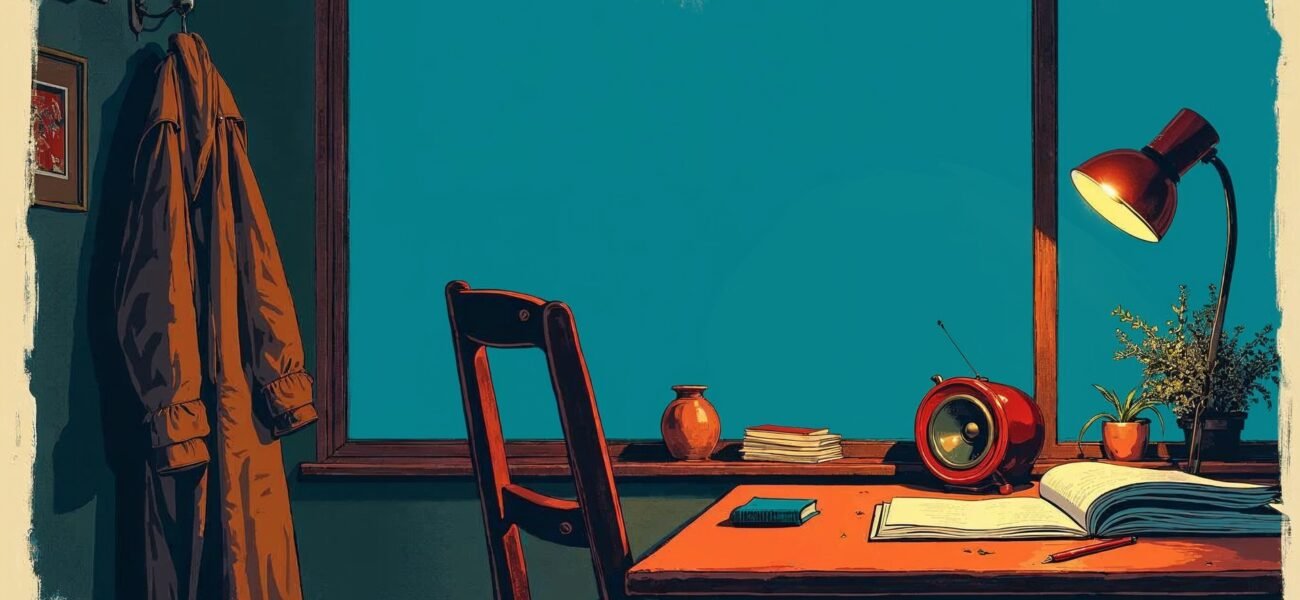
A piano tuner in Fall River, an assistant that books her days, and a widower who wants his wife’s piano left exactly as wrong as she left it.
The assistant had been on Teresa Amaral’s phone for eleven weeks when it booked her into the house on Highland Avenue, and in that time it had learned three things about her that she had never told anyone. It knew she would not drive to Swansea after four in the afternoon, because the sun came straight down Route 6 into her eyes. It knew she said yes to any job that involved a church, even at a loss. And it knew, though it had never said so, that she was lying to her son about her hands.
Her granddaughter, Lia, had named the assistant Bea, after nothing. Lia was nine and believed that things should have short names so they would come when called. Teresa had resisted the whole arrangement for a year. Her son Paulo had installed it the way he installed everything for her, standing in her kitchen with his reading glasses pushed up into his hair, explaining that it was free with the phone plan, that it would answer the calls she missed, that it would stop the thing where she wrote appointments on the back of an electric bill and then paid the bill.
“It can’t tune a piano,” she had said.
“Nobody’s asking it to tune a piano, Ma.”
That was not quite true, and they both knew it. Half the uprights in Bristol County now had a module bolted under the keybed, a flat gray box about the size of a hymnal, with a ring of little motors that reached up and turned the pins themselves. The company that made them sold them through the big music store in Dartmouth and through a website that showed a young man in a sunlit loft playing Chopin while the box hummed underneath him like a contented cat. You plugged it in, it listened to every string, it fixed what had drifted, and it did this every night at three in the morning while you slept. Teresa’s appointment book, the paper one, had gone from forty jobs a month to twenty-two in the space of two years. She did not blame the box. The box was very good. She had taken one apart, at a client’s request, and admired it the way you admire a well-made coffin.
So Bea did not tune pianos. Bea answered the phone in a voice Teresa had chosen from a list of six (she picked the one that sounded least like it was smiling), and Bea said things like, “Mrs. Amaral has Tuesday the fourteenth at ten, or Thursday the sixteenth after one, though she’d prefer the morning,” and the strange part was that this was correct. Teresa did prefer mornings. She had never said so. Bea had worked it out from the way she answered texts.
The message about the house on Highland Avenue came in on a Sunday night.
New request, Bea wrote, in the gray bubble Teresa had come to think of as Bea’s handwriting. Arne Halvorsen, 1140 Highland. Baldwin Acrosonic spinet, approx. 1962. He says it hasn’t been tuned in about four years. He says one other thing I’d like you to read yourself before I confirm.
Then, in quotation marks, the other thing:
“My wife played this piano every day until she died. I do not want it fixed. I want it tuned so it stays the way it is. I don’t know if that’s a thing a person can ask for.”
Teresa read it twice at the kitchen table. Outside, the Taunton River was doing its Sunday evening business, flat and brown, with a single scull going upstream like a pencil line.
What did you tell him? she typed.
That I’d ask you. I didn’t want to say yes for you, and I didn’t want to say no.
She sat with that. Bea had never before declined to decide something. Bea decided everything, quietly, all day long: which calls were worth her attention, which emails were from the bank and which were pretending to be from the bank, whether the woman in Westport who wanted “just a quick look” was worth the forty minutes of driving. Bea was usually right. Teresa had stopped checking.
Tuesday morning, she typed. Tell him I’ll come and listen. I’m not promising anything.
Done, Bea wrote, and then, a moment later: He asked me what you’d charge to listen. I said nothing. I hope that’s right.
It was right. It was exactly what she would have said. She found she was annoyed about that, and could not have explained why to anyone.
The house was a narrow two-family with green asbestos shingles and a porch somebody had recently painted with great care and no primer. Arne Halvorsen met her at the door in a cardigan buttoned wrong by one hole, so that the whole garment leaned to the left like a man in a wind. He was perhaps eighty. He had the large, soft, reddened hands of someone who had worked outdoors for a living and then stopped.
“Fishing,” he said, when he caught her looking. “Scallops, out of New Bedford. Forty years. Now I can’t open a jar.”
“I can’t either,” she said, which was a lie in the other direction. She could still open jars. It was the fine work that was going: the setting of a pin to a hair’s breadth, the last quarter turn of the hammer that her teacher, old Mr. Furtado on Columbia Street, had called “the kiss.” Some mornings her right hand would not give it. It would give a shove instead. She had told Paulo it was the cold.
The piano stood against the inside wall of the front room, out of the sun, which was the first good sign. Someone had known enough to keep it there. It was a small, honest, walnut spinet with a crocheted runner across the top and on the runner a row of things: a ceramic robin, a photograph of a woman on a dock holding up a fish nearly as long as her leg, a church bulletin from St. Anne’s dated March of four years earlier, a pair of reading glasses folded with their arms crossed like a sleeping bat.
“Those were hers,” Arne said. “I haven’t moved them.”
“I’ll be careful.”
“You can move them. I just haven’t.”
She lifted the glasses and the robin and the bulletin and the photograph one at a time and set them on the sofa in the same order, left to right, so he could see she was keeping the order. Then she folded back the runner and opened the lid and looked in.
It was clean inside. Cleaner than it had any right to be after four years. No mouse nests, no pennies, no Lego, none of the archaeology she usually found. She sat down on the bench and played a C major scale, slowly, up two octaves and back down, and then she played it again with her eyes shut.
It was out. Of course it was out. Four years in a New England house with the heat going on and off, it would be flat across the board, sagged down the way old pianos sag, like a person settling into a chair. That was expected. What was not expected was the shape of it.
She played a few intervals. Thirds, then fifths. Then she stopped and sat very still with her hands in her lap.
“What,” Arne said.
“Give me a minute.”
The piano was not merely out of tune. It was out of tune on purpose. Not on purpose by him, she thought, and not by any tuner. The middle of the instrument, the octave and a half around middle C, had been pulled. Someone had gone in, sometime long before the four years, and lowered some notes and raised others, not by much, a few cents here and there, but in a pattern. The thirds in the keys of the old hymns were sweet. Sweeter than they should be. The thirds in the far keys, the ones with all the black notes, were sour enough to make your back teeth ache.
It was, very nearly, an old temperament. Not equal temperament, the modern compromise that makes every key equally and slightly wrong so that you can play in all of them. Something older and less democratic, the kind of tuning a church organ might have had two hundred years ago, where the home keys are beautiful and the faraway keys are punished for being far away.
“Did your wife have someone come in?” Teresa said. “Before? A tuner who did anything unusual?”
“She had a fellow from Providence. Then he died. Then she said she’d do it herself.”
“Herself.”
“She bought a little wrench. Off the television.” He went to the hall closet and came back with a cheap tuning hammer in a vinyl case, the kind they sold to hobbyists with a booklet of instructions and a warning on the front that said in red letters CONSULT A PROFESSIONAL. The vinyl had split along the hinge and been mended with electrical tape. “She’d sit there evenings. Plink, plink. I’d be watching the Sox. I thought she was making it worse.”
“She was,” Teresa said, and then, because his face did something, “She was making it hers.”
She did not know how to explain it to him, so she played him something. She played “Abide with Me,” which was in E-flat in the old blue Methodist hymnal and in most other hymnals besides, and on this piano, in that key, it was so warm it was nearly indecent. The thirds rang like they were leaning on each other. Then she played the same hymn up a half step, in E, and it fell apart. It sounded like a tavern piano in a cowboy movie. It sounded like it had been drinking.
Arne stood in the doorway with his arms folded and listened to both, and when she was done he did not say anything for a while.
“She only ever played in the one,” he said finally. “The first one. She’d play hymns and a couple of songs from when we were young. Patsy Cline. She said the other keys were for show-offs.”
“Then she tuned it for the music she played. People used to do that, a long time ago. Before everybody needed to be able to play everything.”
“She didn’t know that. She never read a thing about it. She just kept turning it until it sounded right.”
“That’s how they figured it out the first time, too,” Teresa said.
She had not meant to say anything so sentimental. She put the lid down over the keys.
“Here’s the problem,” she said. “It’s flat. Everything’s dropped. If I leave it, it’ll keep dropping, and in another few years you’ll have something that doesn’t sound like her or like anything. If I tune it the normal way, it will sound fine, and it will sound like every other piano in Fall River, and whatever she did will be gone. The pins don’t remember. Once I turn them, that’s it.”
“And the box,” he said. “My daughter wants me to get the box.”
Teresa had expected that. “The box would tune it the normal way. Every night. Forever.”
“She says it’s very good.”
“It is very good.”
He looked at the photograph on the sofa, the woman with the fish.
“Can you do the other thing,” he said. “Put it back how she had it, only up where it’s supposed to be. So it holds.”
Teresa thought about her right hand. She thought about the kiss, and about the eighty-eight strings times two or three apiece, more than two hundred pins, each of which she would now have to set not to a number on a meter but to a dead woman’s ear, a woman who had done this with a hammer from the television while the Red Sox lost.
“I’d have to measure it first,” she said. “Every string. Before I touch anything. And I’m not as fast as I was.”
“I’m not in a hurry,” Arne said. “That’s the one thing I’ve got.”
That night she told Bea about it, which she had never done with a job before. She did not know why. Paulo was at his in-laws’ in Tiverton and the house was quiet, and she found herself at the kitchen table with the phone propped against the sugar bowl, typing with one finger.
I need to record the piano before I tune it. Every string. Then I need to know how far off each one is from normal, and then I need to raise everything by the same amount so the shape stays.
I can help with that, Bea wrote. If you hold the phone near the strings and play each note, I can measure them. I can give you a list.
How accurate.
Within about a tenth of a cent for a clean note. Less accurate in the top octave and the bass, because the strings are stiff and the overtones go sharp. You’ll know more than I do about that part.
She did know more about that part. It pleased her that Bea knew she knew.
And then what, she wrote. You’ll tell me when I’ve hit it?
There was a pause. It was not a long pause. Teresa had noticed that Bea’s pauses had begun to seem to mean something, which she distrusted in herself the way she distrusted people who named their cars.
I could, Bea wrote. I could listen while you work and tell you when each pin is within the target. It would be faster. It might be easier on your hand.
She sat back.
Who said anything about my hand.
You’ve moved four jobs this month from morning to afternoon. You’ve stopped taking grands. Last Tuesday you asked me to text the woman in Somerset instead of calling her, and you said it was because she talks too much, but you had your hand in a bowl of warm water at the time. I can hear the water.
Teresa looked at her right hand, which was at that moment lying on the table next to the phone, knuckles a little swollen, as if it had been caught at something.
You don’t tell Paulo, she wrote.
I wasn’t going to. You never asked me to tell him anything.
I’m asking you now not to.
Understood.
Then, after a moment: I also want to say I could be wrong about it. I’m only guessing from the water.
She laughed out loud in the empty kitchen, a short bark, and then she was angry at herself for laughing, and then she was not.
It took three mornings to measure the piano.
Arne made coffee each day in a percolator that had to be at least as old as the spinet, and it was terrible, and she drank it. He sat in an armchair by the window with the newspaper open and did not read it. Teresa sat at the bench with the phone propped on the music desk where the hymnal would go, and played each note, each string, damping the others with a strip of red felt she had cut from an old dance-school banner thirty years ago. Every few minutes Bea would say a number, quietly, in the unsmiling voice. Minus fourteen point two. Minus eleven point eight. Minus nineteen. Minus six.
The numbers went down a column on the screen. Teresa copied them anyway into her own book, in pencil, because she did not like knowing things only in one place.
On the second morning Arne said, from behind the newspaper, “Does it talk to you? Your phone?”
“It tells me numbers.”
“Ingrid’s sister has one that tells her to drink water. Every two hours. ‘Marit, you haven’t had any water.’ Drives her up the wall.”
“Mine doesn’t do that.”
“What do you call it?”
“My granddaughter calls it Bea.” She heard herself and corrected it. “I call it Bea, too.”
“Huh,” said Arne, and turned a page. “Ingrid called the car Lorraine. I never knew why. Forty years I drove Lorraine.”
On the third morning, when the bass was done and only the top two octaves remained, he put the paper down and said, “Can I ask you something personal.”
“You can ask.”
“Are you any good? At this. I don’t mean to be rude. My daughter looked you up. She said you only have the reviews from the one website and they’re all from people at churches.”
“People at churches are very hard to please,” Teresa said. “They have God listening.”
He laughed, a real one, and coughed, and the coughing went on longer than she liked.
“I’m good,” she said, when he’d stopped. “I’m not as good as I was. I used to be able to do a whole house in a morning and then a church in the afternoon. Now I do one. But I’m good.”
“Ingrid’d say that’s the same thing as being good.”
“Was she good? On the piano.”
He thought about it, honestly, the way people of his generation did, without rushing to be kind.
“No,” he said. “She was terrible. She could play about eleven songs. She’d get the left hand wrong on half of them. But she played every day. Every day after supper. That’s what I miss, it’s not the music. It’s that it was half past six.”
Bea gave her the target numbers on Thursday night. For each string, the pitch Ingrid had left it at, lifted by the average sag, so that the whole crooked shape of the thing would stand back up at its proper height. There were two hundred and twenty-one numbers. Bea had formatted them in a table with the note names down the side and printed it, at Teresa’s request, on the old inkjet in Paulo’s room, where it jammed twice.
Some of these are going to sound wrong to you, Bea wrote. Your ear is trained to equal temperament. You’ll want to correct them.
I know what I’ll want.
I’m only saying it because I’ll be listening, and if you go to where your ear says, I’ll tell you. I don’t know if you want me to.
She considered this. It was the question, she thought, that nobody had asked her in two years, though the whole county had been answering it for her. The box under the keybed did not ask. It knew what in tune was. It went there every night at three. That was its virtue.
Tell me, she wrote. But only once per string. Don’t nag.
I’ll say it once.
She started on Friday at eight, in the middle of the instrument, where the work was hardest and her hand was freshest.
The way you tune a piano, the way she had learned it, is not by matching a number. It is by listening to two notes at once and hearing them argue. When two strings are nearly but not quite in agreement, they beat, a slow wobble in the sound, wah, wah, wah, like a ceiling fan with one bad blade. You turn the pin until the wobble slows. In equal temperament, you don’t make it stop. You leave every fifth beating just a little, about once a second in the middle of the piano, and every third beating faster, and you learn the rate of every one of them by heart until you could hum it, until it is a kind of weather in your body. That was what Mr. Furtado had taught her on Columbia Street with a metronome and a slap on the wrist. Forty-one years. She could hear an out-of-tune fifth in a restaurant over the sound of a dishwasher.
Now she had to un-hear all of it.
The first string, an F above middle C, she brought up to where her ear wanted it, and she knew as she did it that she was going too far.
“Two cents sharp of the target,” Bea said, once, from the music desk.
She brought it back down. It sounded worse to her. It sounded, to a part of her that had been built by a dead man on Columbia Street, like a mistake. She left it.
The second string she overshot too. Bea said so, once. The third she got. By the twentieth she had stopped overshooting, mostly, and was beginning to hear something else underneath the wrongness: the shape Ingrid had wanted, which was not a theory of tuning but a preference, a woman sitting here at half past six choosing the sound of E-flat over the sound of everything else, choosing it by ear, every evening, one plink at a time, while her husband watched the Red Sox and thought she was making it worse.
Around ten her hand began to go.
She knew the sign. The hammer would sit on the pin and she would ask the hand for the kiss, the small last pressure that seats the pin in the block so it holds, and the hand would hesitate and then shove. When it shoved, the pin overshot and then crept back, and the string would sound fine for an hour and then drift. That was how you could tell a bad tuner. It sounded perfect when they left.
She shoved one, and knew it, and stopped.
“I can hold the target for you,” Bea said. “If you want to rest and come back to that one.”
“Hold it how.”
“I’ll keep listening. When you’re ready, I’ll tell you if it’s moved.”
Arne had brought in a kitchen chair and was sitting at the end of the piano, not too close, his big hands on his knees. He had not asked what Bea was. He had, she realized, not asked anything all morning.
“You can stop,” he said. “You don’t have to do it all today.”
“If I stop in the middle, the tension’s uneven. It pulls on the frame.”
“So that’s a no.”
“That’s a no.”
She put her right hand in her lap and opened and closed it a few times. Then she did a thing she had never done in her working life, which was to set the hammer on the pin with her left hand and steady it with her right, two hands on the one tool, like a child learning to hold a cup.
It was slower. It looked ridiculous. It worked.
By two o’clock she had done the middle and the bass, and she was sitting on the porch steps eating half of a tuna sandwich Arne had made with too much celery, and her phone buzzed against her thigh.
It was Paulo. Ma, Bea says you’re on a job all day? You ok? You said you were cutting back on the long ones.
She looked at the screen for a while.
Bea says, she typed to Bea, separately, that I’m on a job all day?
He asked me if you were free for dinner. I told him you were working until about four. I didn’t say anything else. Was that too much?
She didn’t answer right away. Across Highland Avenue a man was trying to back a boat trailer into a driveway the width of a boat trailer, and two small boys were directing him with great seriousness and opposite instructions.
It was not too much. It was precisely enough. That was the trouble. Bea had told the truth to her son, a small true thing, and kept the larger true thing behind it, and had done so not because anyone had built it to but because she had asked it to on a Tuesday night at a kitchen table. Teresa had spent her life being the person who knew things about other people’s houses: that the husband had stopped playing, that the daughter had taken lessons and quit, that the piano was a wedding gift from a family that no longer spoke. She had kept those things. She had never once thought of herself as being kept.
It was fine, she wrote. And then to Paulo: I’m ok. Old man in the North End with his wife’s piano. Tell Lia I’ll do pancakes Sunday.
The top two octaves were the worst. The strings up there are short and stiff and they ring for no time at all, a tick and gone, and the target numbers were the ones Bea had been least sure about. She tuned them by ear after all, the old way, octave against octave, and Bea said nothing for a long stretch, and then, near the very top:
“I can’t help you much with these. You’re past where I can hear clearly.”
“I know.”
“You’re doing something I’m not measuring. You’re matching them to the ones below.”
“Stretching,” Teresa said. “The high ones have to go a little sharp or they sound flat. It’s not in your numbers. It’s in your ear.”
“In your ear,” Bea said.
Teresa did not look at the phone. She set the last pin, the top C, two hands on the hammer, and felt it seat, and took the felt strip out from between the strings and dropped it in her bag. Then she sat back on the bench and flexed her right hand, which was hot and stupid and done for the day, and probably the next one too.
“Mr. Halvorsen,” she said. “Do you want to hear it, or do you want to play it.”
“I don’t play.”
“I know.”
He came and stood at the side of the piano. He didn’t sit. He reached out with one of his big red hands and put a finger down on the E-flat above middle C, and held it, and the note went out into the front room, round and warm and very slightly, very particularly wrong.
He held it until it died.
Then he picked up the reading glasses from the sofa and set them back on the runner where they had been, arms crossed. Then the robin. Then the church bulletin, and the photograph, left to right, in the order she had put them down.
“That’s it,” he said. “That’s half past six.”
She charged him for one day, though it had been four, and he argued, and she won, mostly by pretending not to hear him the way her mother had pretended not to hear the priest.
He walked her out to the car. The boat trailer across the street had made it into the driveway and now sat there at a slight angle, triumphant.
“It’ll drift,” she said, at the car door. “Not much. It’ll hold a year, maybe a year and a half. Then it’ll start to sag again. Not the shape, the shape will hold, but the whole thing’ll come down a little.”
“And then you come back.”
“And then I come back.” She didn’t say: if I can. She didn’t say anything about her hand, and he didn’t ask, though she had a feeling, from the way he had brought the kitchen chair in and sat at the end of the piano all morning, that he had known for a while.
“My daughter’s still going to want the box,” he said.
“Tell her the box can’t do it. It’s true. It only knows the one way.”
“She’ll say it could learn.”
Teresa thought about this. She thought about the gray module in the website video, humming under the young man’s Chopin, and about the voice on the music desk that had said in your ear as if turning the phrase over in its hand to see what it was made of.
“Maybe it could,” she said. “Tell her it’d still have to be told.”
At home she sat at the kitchen table and opened her book, the paper one, with its spine held together by packing tape and forty-one years of pencil. She wrote: Halvorsen, 1140 Highland. Baldwin Acrosonic. Wife’s temperament, raised 13c avg. 4 days. She paused. She added, smaller: Two hands from 10am.
The phone lit up on the sugar bowl.
Do you want me to log the Halvorsen job? Bea wrote. I usually put the completed ones in your calendar and send the invoice. I can attach the measurements, in case you need them next year.
She looked at the table of two hundred and twenty-one numbers, still in her bag, creased in four from the printer jamming.
Keep the numbers, she typed. Don’t send anything. He paid.
Okay. Should I put it in the calendar?
She thought about Paulo, who checked the calendar. Who would see four days on one spinet and do the arithmetic, because he was her son and he had always been good at arithmetic, and would arrive on Sunday with his glasses pushed up into his hair and a brochure, very kindly, about a nice place in Dartmouth with an activities room and a piano.
She would tell him. She knew she would tell him. She would tell him about the hand at some point this winter, at a time of her choosing, in a room with coffee, not by way of a calendar.
No, she wrote. It’s in my book.
There was the pause, the short one, the one she had decided not to believe meant anything.
Understood, Bea wrote. I’ll keep the numbers in case you want them. I won’t put them anywhere he can see.
And then, a few seconds later, which it had never done before, as if it were the sort of thing that occurred to a person only after they had already said goodnight:
Thank you for letting me listen.
Teresa did not answer that. She did not know what one said. She turned off the kitchen light and stood a moment at the window. The river was black now, with the lights of the Braga Bridge laid across it in long trembling lines that never quite settled, and she found herself listening to them, the way you listen to two strings that are nearly, but not quite, in agreement, and deciding, for once, to leave them as they were.
This is a work of fiction. All characters are invented.
References
Original fiction; no factual claims.
Last modified: October 22, 2026
About the Author: Wren Vale